Can You Overfeed Isopods?
Can You Overfeed Isopods?
Yes, you can overfeed isopods, but it depends a lot on the species and the size of the colony.
Some species are heavy eaters and fast breeders. Others grow slowly and can be much more picky. In my experience, learning how much each colony actually eats is more useful than following one feeding rule for every isopod.
The 1 to 3 Day Rule
For species that are not insanely prolific, I try to feed enough that they clean out their food in about 1 to 3 days.
If everything disappears quickly, I can add a little more next time. If food is still sitting there several days later, I usually clean it out and give them a fresh serving.
This is especially useful with smaller colonies that simply cannot eat large amounts of food very quickly.
What I Feed
Personally, I regularly feed:
- Repashy Morning Wood
- Freeze-dried green peas
- Freeze-dried minnows
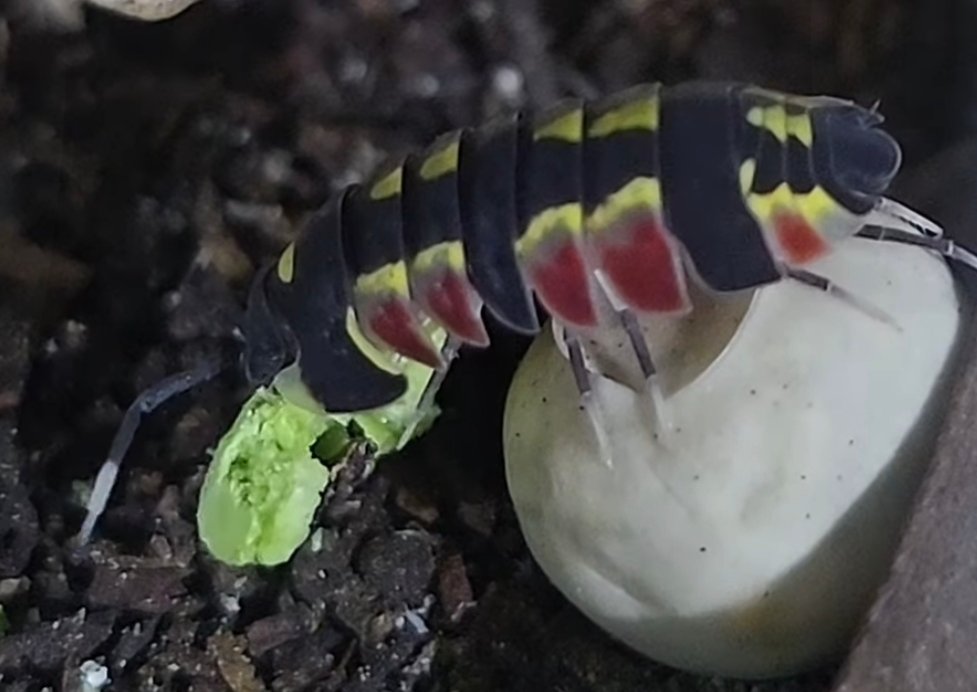
Ardentiella sp. Red Diablo eating a new powder freeze dried pea, while sitting on an old pea. We recommend breaking them up, or they sit like the one in the photo and don’t tend to get eaten.
Different foods act differently inside a warm, humid isopod enclosure. Some foods mold faster than others, and some hold more moisture as they sit.
That is something you need to keep in mind when deciding how much food to add.
Fresh Food Can Make a Difference
In my experience, some isopods can also be surprisingly picky about older food.
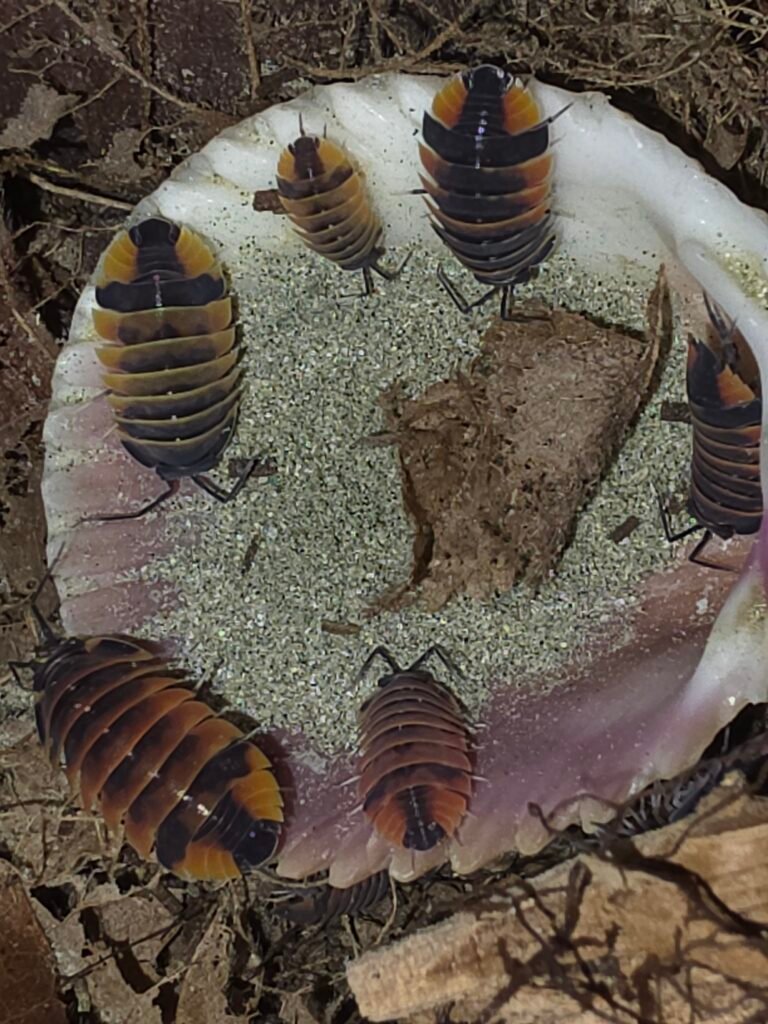
I have noticed this many times with Repashy Morning Wood. I will put some in a small seashell, and after several days there may still be some left. It can look perfectly fine, but the isopods are barely touching it.
I can clean out the shell, add fresh Repashy, and sometimes see isopods eating the new food almost immediately.
So, in my experience, food still being in the dish does not always mean the colony is not hungry. Sometimes they simply are not interested in that older food anymore.
Watch Out for Food They Carry Away
Another problem is that isopods don’t always leave their food where you put it.
Let’s say you have a small colony of a larger isopod species and you add several freeze-dried peas.
An isopod may grab a pea and drag it underneath a piece of cork bark or another hide. You may check the feeding area, see that the pea is gone, and assume they ate it.
Then a week later you lift the hide and find a large web of mold growing from the food they never finished.
This is one reason it is important to be mindful of how much food you give a smaller colony.
It is also one of the reasons we like feeding Repashy Morning Wood as a powder. The isopods can eat it where it is placed, but they cannot easily grab a large piece and carry it somewhere you cannot see.
Some Species Can Handle Much More
Very prolific species can be completely different.
In my experience, some large, fast-growing colonies can be given a big pile of food and will continue eating until it is gone. Some do not even seem bothered when the food starts growing a little mold. They will keep eating it anyway.
Other species are much more picky.
This is why the 1 to 3 day rule is more of a guideline than a strict rule.
A huge colony that destroys everything you give it obviously needs more food than a small colony of a slower species.
Leaf Litter Doesn’t Count
When we talk about overfeeding, we are talking about supplemental foods.
Leaf litter and decaying wood are different. These should be available in the enclosure because they are an important part of an isopod’s natural diet.
You do not need to remove leaf litter because it has been sitting there for three days.
Pay Attention to Your Colony
There is no perfect amount of supplemental food that works for every isopod colony.
In my experience, the best thing you can do is simply pay attention.
For smaller or less prolific colonies, try to give them an amount they can finish within 1 to 3 days. Check underneath hides from time to time to make sure food has not been carried away and forgotten.
For huge, hungry colonies, you can usually feed much more.
If food constantly sits around, molds, or gets dragged away and left uneaten, cut back.
Let the colony show you how much food it actually needs.